Vessum › Blog › What happens if you forget your passcode, or if you die
What happens if you forget your passcode, or if you die
There is no reset, no proof of identity, no support ticket that helps. What that actually costs you, what should never be the only copy, and what your family will and will not be able to open.
If you forget a Vessum passcode, the space it opened is gone. Not suspended. Not recoverable with proof of identity. Not restorable by us, by Apple, or by anyone with the right paperwork. Gone, permanently, with everything inside it.
That is not a gap we intend to close in a later version. It is the direct consequence of the thing the app is for, and it is worth understanding properly, because it has a second consequence that almost nobody thinks about until it is too late.
Why there is no "forgot passcode"
A recovery option is a promise that something was kept.
To offer you a way back in, an app has to hold something: your passcode, a hash of it, a key escrowed on a server, an answer to a security question. Whatever it keeps is a thing that can be read off the device, subpoenaed, leaked in a breach, or handed over by the company that holds it.
Vessum keeps none of it. Your passcode is typed, used to derive a key, and forgotten in the same instant. There is nothing on the phone to compare a guess against, which is exactly why nobody can count your spaces or prove that a second one exists. The full argument for why that matters is in decoy passwords and why most of them do not work.
So the honest summary is short. There is no reset screen. There is no recovery email. If you write to us having forgotten a code, we will tell you what this page tells you, and we will not be able to do anything else.
The part people only think about afterwards
Here is the consequence that catches people out.
The same property that stops a stranger opening your space stops everyone else opening it, including the people who will one day need to. Your executor. Your partner. You, on a new phone, standing in a shop with the old one gone.
Most apps quietly solve this for you through iCloud. Vessum does not, and it is better that you know exactly how far that goes.
It is not in your iCloud backup
Vessum's storage lives in a folder that is explicitly excluded from backup, and the files are written with complete protection, which means they are unreadable while the phone is locked.
Three things follow from that, and all three are worth reading twice.
A new phone restored from your backup will have Vessum on it and nothing in it. The app comes back. The spaces do not.
If the phone is lost, stolen, destroyed or wiped, the contents are gone, even if you remember every passcode perfectly. The passcode opens the file. It does not conjure one.
There is no copy anywhere for anyone to compel. No encrypted blob sitting in iCloud that a court can order produced, no server of ours holding anything, no second place where the number of your spaces could be counted. That is the point. It is also the cost.
Apple's Legacy Contact, which lets someone you nominate reach your iCloud data after you die, does not reach this. It is a key to your iCloud account, and Vessum's contents were never in it.
The test to apply to everything you put in
Before an item goes into any space, ask one question: who else needs this, and when?
| What it is | Who else needs it | Where it should live |
|---|---|---|
| Private photographs, old correspondence | Nobody, ever | Only here is fine |
| Passport and ID scans | You, from a new phone, in a hurry | Here, and somewhere you can reach without this phone |
| Insurance policies, deeds, signed contracts | Your family, eventually | Here, and with the rest of the paperwork |
| Account recovery codes | You, at exactly the moment the phone is gone | Never only here |
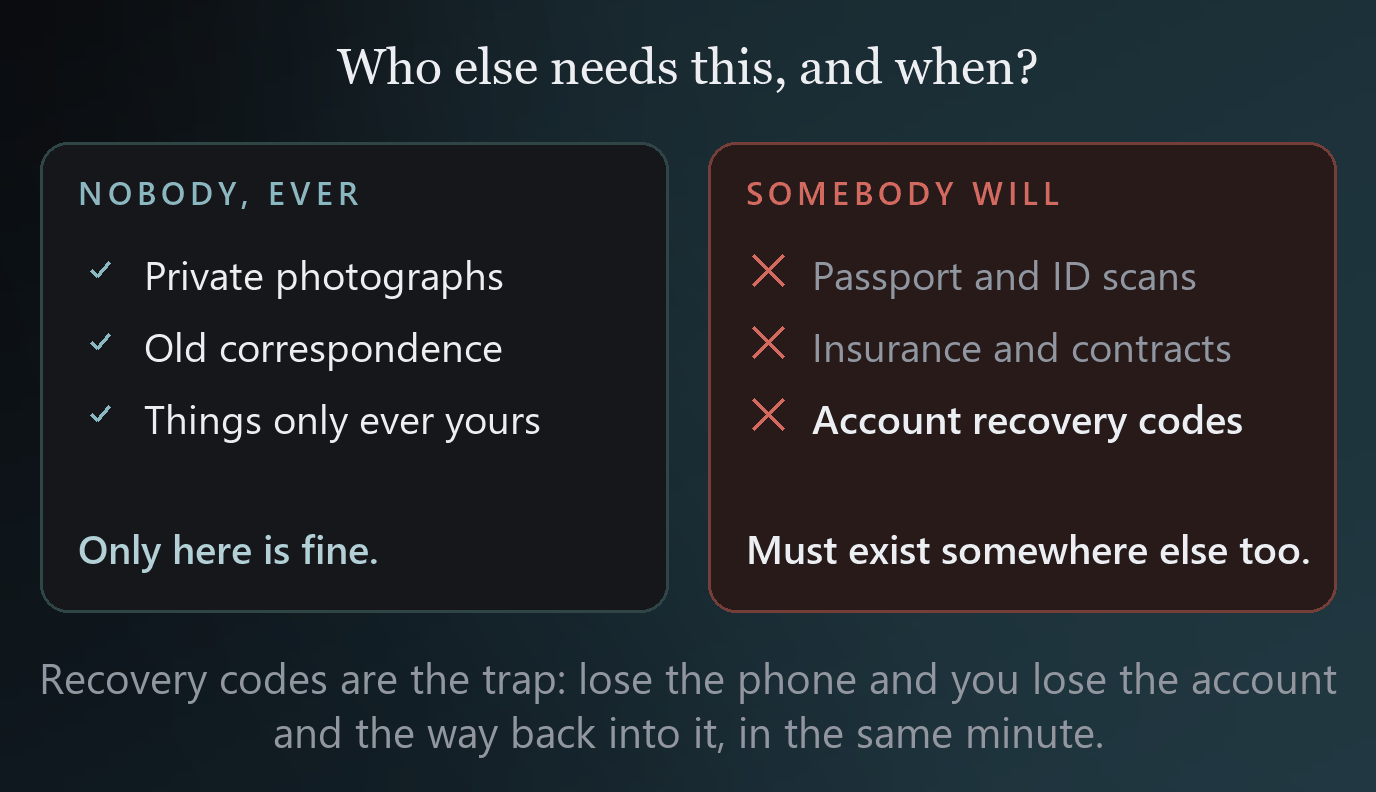
That last row deserves saying plainly, because it contradicts the obvious instinct and because we have recommended putting recovery codes in your real space elsewhere on this blog. That advice stands, with one correction: put them there as well, not only there.
Recovery codes exist for the day you lose access to something. If the only copy of your account recovery codes is inside a vault on the phone you just lost, you have lost the account and the way back into it in the same minute. It is a single point of failure that feels like good security right up until the moment it is tested.
Getting things back out
Vessum will hand you an item whenever you can open the space it is in. Open the item, choose Export, and it writes out to Files or anywhere else you can send it.
One item at a time, deliberately. There is no bulk export, because a bulk export is a single action that empties a space, and a single action that empties a space is a very attractive thing to make somebody perform.
So the working habit is this: when you put something into a space, decide in that moment whether a copy needs to exist outside it. If it does, export it then, while you are already thinking about it. Nobody ever does this later.
Writing three codes down
The setup guide tells you to write your codes down, labelled, somewhere physical and away from the phone. That is right, and there is a tension in it worth naming.
A piece of paper reading "real / decoy A / decoy B" undoes the entire arrangement for anyone who finds it. You have moved the secret from a device that resists inspection onto a sheet of paper that does not.
Three practical rules:
- Label them so they mean something to you and nothing to a finder. Not "real" and "decoy". A word only you would connect to the right space.
- Keep the paper where a stranger would not be. The paper is now the weakest part of the system. Treat it like a spare key to the house, not like a note on the fridge.
- Do not photograph it. A photograph of your passcodes lives in the camera roll, which is the first place anybody looks and the one place this whole exercise was meant to keep things out of.
What to do this week
Three things, in order of how much they matter.
Go through your real space and find anything that someone else would one day need. Insurance, contracts, account codes, anything your family would have to reconstruct from nothing. Export a copy of each to wherever your important paperwork already lives.
Decide, deliberately, whether your vault dies with you. For a lot of people the honest answer is yes, and that is a perfectly good answer. Spaces full of things that were only ever yours are supposed to end. Just make that a decision rather than an accident.
Then write the codes down properly, labelled in a way that means nothing to anybody else, and put the paper somewhere you would put a spare key.
If you want the reasoning behind why none of this can be softened, decoy passwords and why most of them do not work sets out the test the app was built to pass. If you are here because you are worried about somebody asking for a code rather than about losing one, when somebody demands your passcode is the page for that.
Vessum
Photographs, documents and notes behind more than one passcode. Each one opens a different space, and none of them can prove the others exist.
Download on the App Store