Vessum › Blog › Setting up Vessum: the decoy, and the decoy inside it
Setting up Vessum: the decoy, and the decoy inside it
A real space, a decoy, and a decoy inside the decoy. How to build layers that feel like a search ending rather than a search being blocked.
Vessum takes about three minutes to set up and about an hour to set up properly. The difference is entirely in what you put inside it, and in one idea that most people never think of: the decoy needs a decoy of its own.
This is the long version. If you only read one section, read the space inside the space.
Why one decoy is not enough
Picture how a search actually goes.
Somebody has your phone and knows Vessum is on it. You give them a passcode. They open a space, look through it, and find some private things. Then they go into Settings, where every space lists the spaces it created, and they see that this space made another one.
Now they know there is more. And you are standing there with an obvious next move available to you.
A single decoy fails here, because it ends with the snooper knowing something is being withheld. That is the worst possible outcome: you have proven there is more without showing it, which is a stronger result for them than if you had never used an app at all.
What you want instead is for the search to end, with them believing they got to the bottom. That takes three spaces.
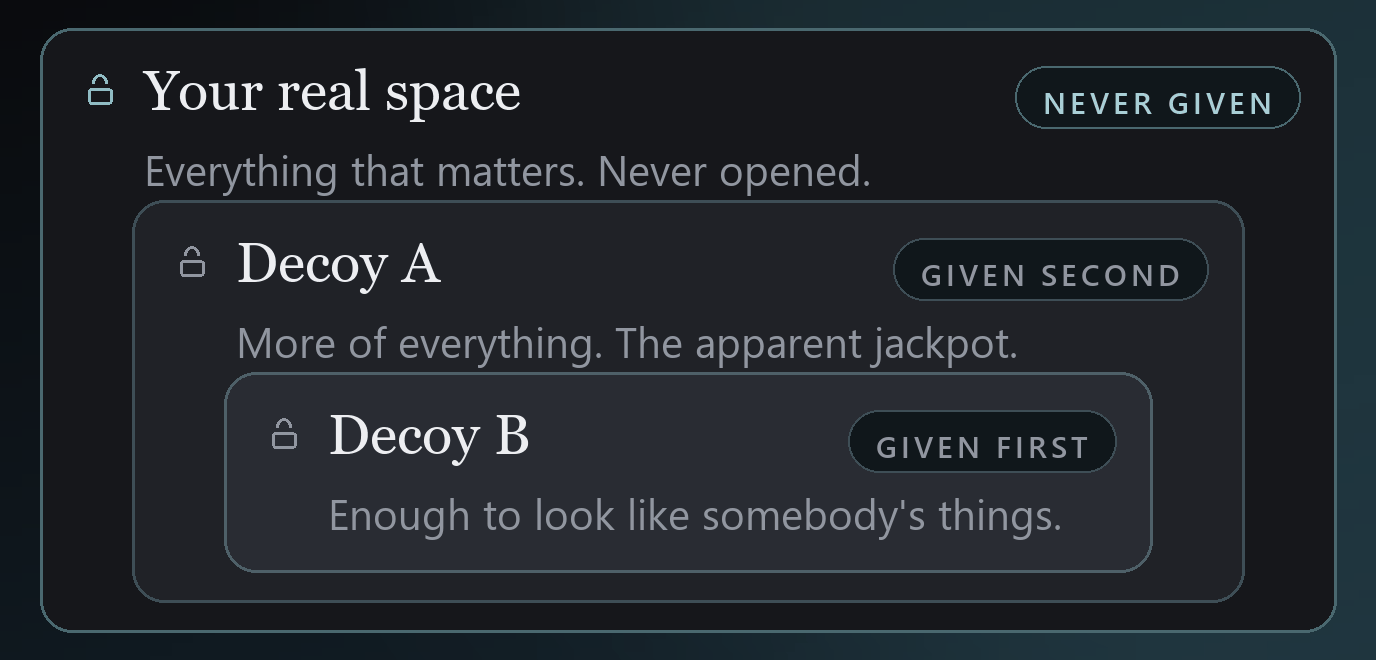
The three spaces
| Space | Who gets it | What is in it |
|---|---|---|
| The real one | Nobody, ever | Everything that genuinely matters |
| Decoy B, inside A | Given first, with visible reluctance | A moderate amount of private material. Children of its own are optional |
| Decoy A | Given second, with more reluctance | More than B. The apparent jackpot. Visibly has a child |
In Vessum you build this by creating A from inside your real space, then creating B from inside A. A space lists what it created and never what created it, so from inside A there is no trace of the real space at all.
Before anything: write three passcodes down
You now have three codes and none of them can be recovered by anyone, including us. There is no reset.
Write all three down, clearly labelled, somewhere physical and away from the phone. Being unsure which is which under pressure wrecks the whole arrangement, and it is a surprisingly easy mistake to make when you are nervous.
Space one: the one you keep
Create it on first launch. Name it anything; the name is only for you.
Put in what actually matters: identity documents, bank and tax papers, medical letters, signed contracts, recovery codes, the photographs that are genuinely yours alone.
Then stop thinking about this space. You are not going to open it in front of anyone, ever.
Space two: Decoy A
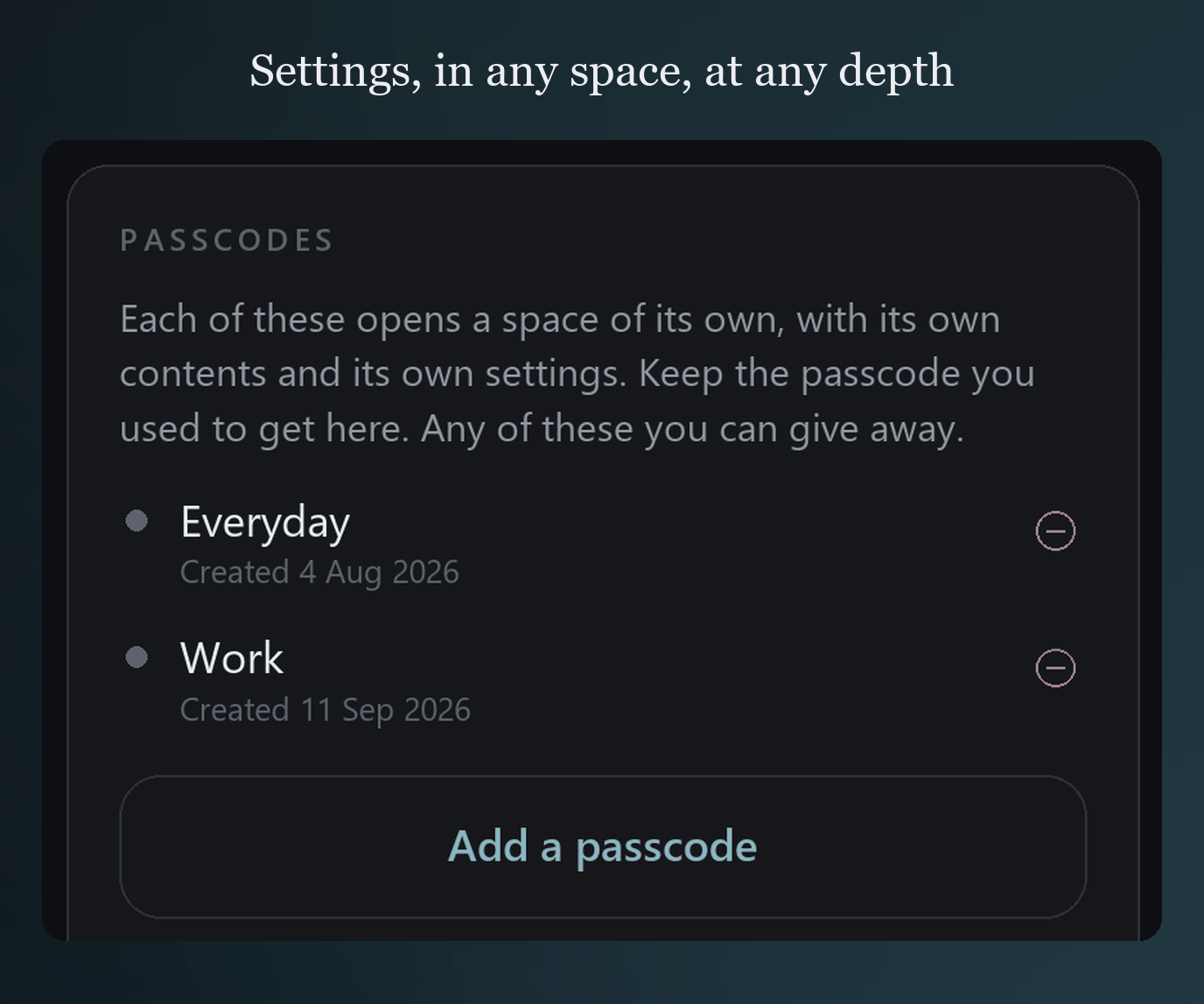
From inside your real space, open Settings, then Passcodes, then Add a passcode.
This is the space you hand over last, and it is the one that has to look like the jackpot. It needs to be worth finding, but losing all of it should cost you nothing.
Documents and photographs
Twenty to thirty items, with varied dates. Holiday photographs, a pet, food pictures, a few screenshots. An old utility bill, a gym membership, last year's insurance, an out of date CV, a payslip, a rental inventory.
The notes with passwords in them
This is what makes a vault feel like a vault. Nobody believes a private vault that contains holiday photographs and nothing else. People keep vaults because they keep credentials in them.
So put a few notes in with passwords. But be careful which, because you are going to hand these to a stranger.
Safe to use:
- Passwords you have already changed. An old one that no longer works anywhere. This is the best option by a distance, because it costs exactly nothing.
- Low stakes accounts you can re-secure in a minute. A streaming service. If somebody takes it, you change it that evening and nothing has happened.
- A dormant email address you do not use for anything, with no password resets pointed at it.
- An old card PIN for a card that has expired or been replaced.
Never use:
- Anything protecting money. Banking, payment apps, crypto, your main card.
- Your primary email, which can reset half your other accounts.
- Your work email or any employer system. Your employer's security is not yours to trade away, and handing over a work credential may breach your contract regardless of how little is in the mailbox.
- Anything that shares a pattern with a live password.
Write the notes the way you actually write notes. Not a tidy table called "Passwords". Something like a note titled "netflix" with two lines in it, and another called "old card" with four digits and nothing else. Tidy is suspicious. Scrappy is real.
Leave the child visible
Do not try to hide that Decoy A created another space. That is the mechanism. The child listed in A's Settings is Decoy B, the space you handed over first, so by the time they reach A there is nothing left that points anywhere new. The search closes on itself.
The space inside the space
From inside Decoy A, open Settings, Passcodes, Add a passcode again.
This is Decoy B, and it is the space you hand over first.
A has to be richer than B
If A had less in it than B, nobody would believe A was worth holding back. A is the one you give up last and with the most reluctance, so it has to feel like the real find.
So put more in A. More photographs, more documents, and more of the credential notes. This is where the bulk of the material goes. B gets a dozen to twenty items, which is enough to look like somebody's private things without looking like the end of the line.
Leave a few things out of A, deliberately
Here is the detail that makes the difference, and it is not obvious.
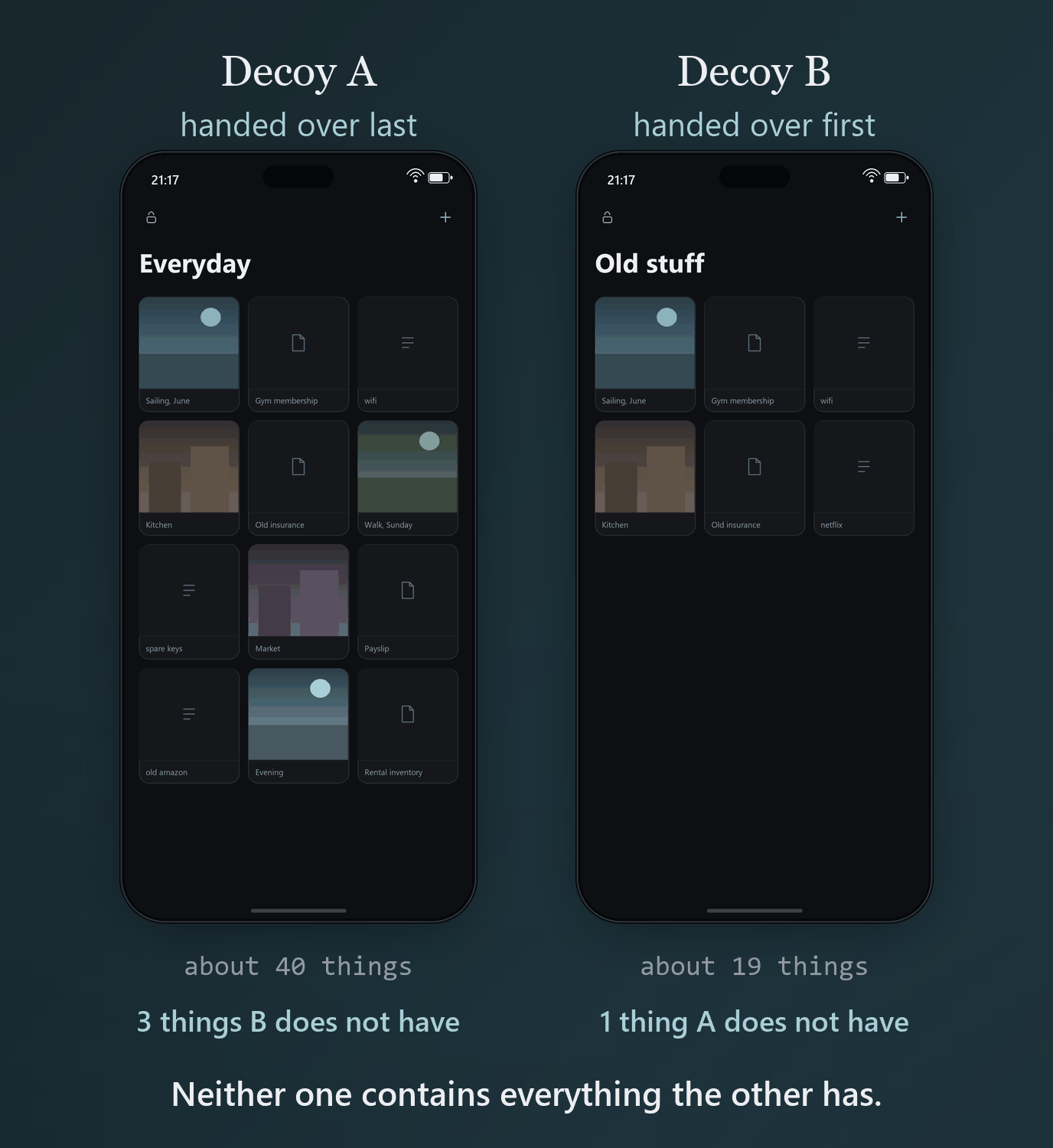
Do not make B a smaller copy of A. Neither space should contain everything the other has. Keep two or three things only in B: the streaming password, the dormant email, a couple of the photographs.
The reason is that two real collections never nest perfectly. If somebody compares the two spaces and finds that B is simply a copy of A with things removed, it reads as fake, which is what a prepared set looks like. If each space has something the other lacks, they read as two different collections, made at different times, for different reasons.
That is what the inside of a real person's phone looks like: slightly disorganised, slightly redundant, slightly inconsistent.
B's children
If you have time, give B decoy spaces of its own. A space that has created spaces looks more like a space somebody actually uses, and it gives the first pass of the search somewhere to go.
They open B. They work through whatever B created. They come back and press you anyway, and you give up A. A is richer than all of it, and the one space A points to is the one they started with. At that point the snooper has more than they can hold in their head and no thread left to pull, which is the moment they decide A was the top of it.
A worked example
| Decoy A | Decoy B | |
|---|---|---|
| Photographs | 31 photos, two trips, a birthday, a holiday and pet photos | 14 photos, two trips and a birthday |
| Documents | Gym membership, old insurance, a payslip, a rental inventory, a love letter | Gym membership, old insurance |
| Notes | wifi, spare keys, old amazon password, a bank statement with a small balance | wifi, old amazon password, netflix |
| Only here | The payslip, the bank statement, most photos | netflix, dormant email note, 3 photos |
| Children | One, visible in Settings | At your discretion |
Neither column is a subset of the other. Both look like somebody's private things. The first looks like more of a find than the second.
How it actually plays out
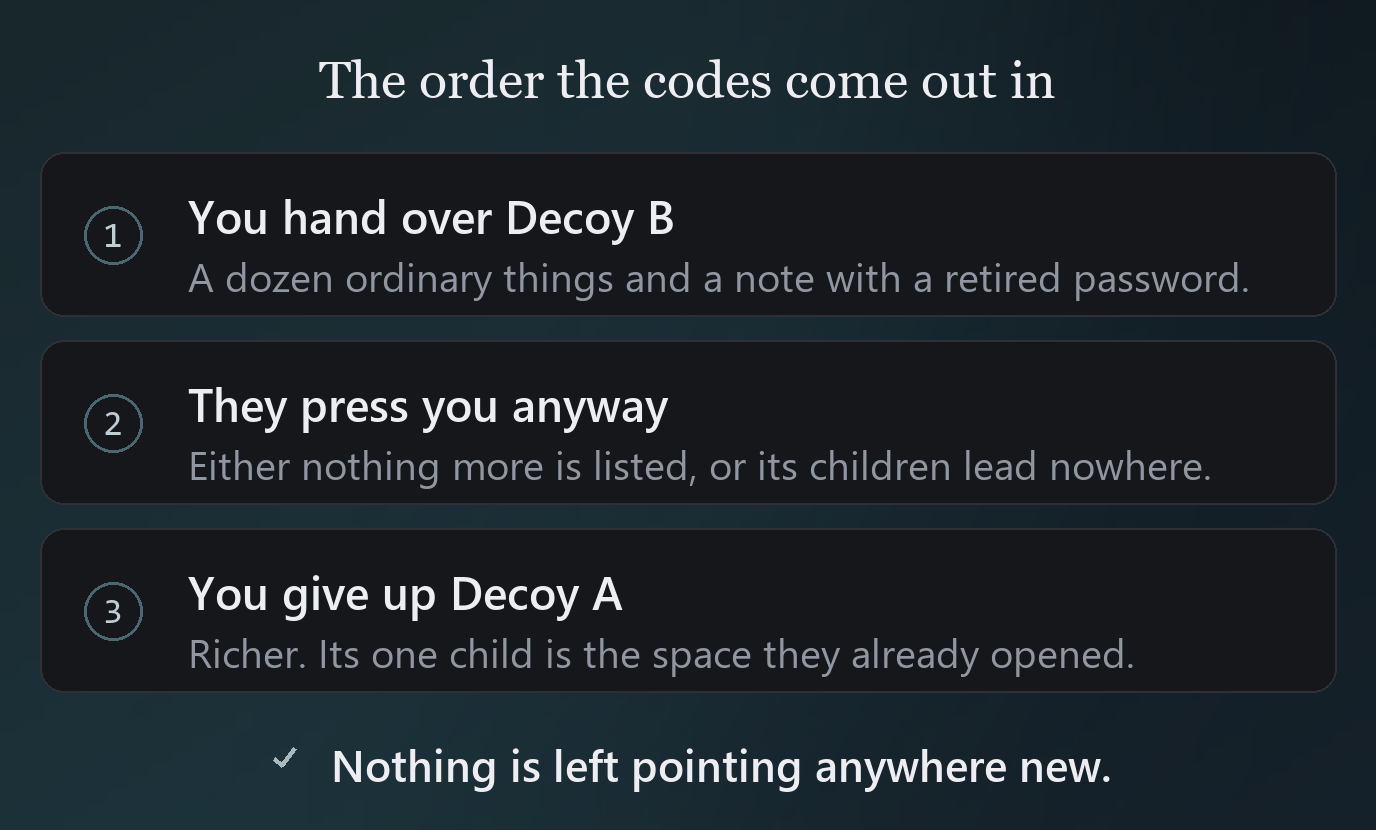
You hand over Decoy B's code with some hesitation, because hesitation is the honest reaction and you do not have to fake it.
They look through Decoy B. They find the notes with passwords, which is the moment they start to think they are getting somewhere. Then they either find another space listed in Settings or find nothing listed at all, and either way they ask whether you are hiding something else.
You give them Decoy A, with more reluctance. They open it and find more of everything, including the material that felt like it was being protected. Decoy B is below it.
At that point most searches stop, because there is no reason to keep going and nothing left to point at.
Remembering three codes under pressure
Make them easy for you and unrelated to each other. Do not use a sequence, do not use variations of one number, and do not make the real one the hardest to type.
Practise opening each of them once a week for the first month. The failure mode here is not somebody breaking in. It is you, standing in front of someone, drawing a blank.
Where this stops working
Four honest limits.
You can over-engineer it. If you produce two passcodes smoothly and in order, it reads as rehearsed. The strength of this is that each step looks like a small defeat, so do not perform it well.
It is a defence against a person, not a laboratory. None of this changes what forensic extraction recovers. If that is your situation, see crossing a border with your phone, where the honest advice is to not carry the data.
That Vessum is installed is not hidden. It cannot be. What stays hidden is how many spaces exist and what is in them.
Giving away credentials has a cost even when chosen well. Change the streaming password afterwards. Treat anything in a decoy as burned the moment it is seen.
The checklist
- Three passcodes, written down, labelled, away from the phone.
- Real space: everything that matters. Never opened in front of anyone.
- Decoy A: twenty to thirty varied items, notes with retired or low stakes passwords, and one visible child space.
- Decoy B: a dozen to twenty varied items, two or three of them things that A does not have, and children of its own if you want them.
- Nothing in any decoy that protects money, your main email, or your employer.
- Practise all three codes until they are automatic.
If you want the reasoning behind the design rather than the instructions, decoy passwords and why most of them do not work explains the test Vessum was built to pass, and when somebody demands your passcode covers the situation this is all for.
Vessum
Photographs, documents and notes behind more than one passcode. Each one opens a different space, and none of them can prove the others exist.
Download on the App Store